POKER DICTIONARY for beginners
Anyone who reads poker texts will quickly notice that this language is very specific and full of various phrases that are either not translated at all or only partially translated. And the translations can be even more misleading, because no one who doesn’t know poker will have any idea what a street, position or rainbow is. That’s why the poker dictionary is coming back to PokerTexas, which should make entering the world of poker easier.
A
The highest level of play that a poker player can achieve.ABC Poker
The ABC of poker means playing in a textbook way, without paying attention to how your opponents play in particular situations. The ABCs of poker do not mean that a player who plays this way is playing badly. It only means that his moves are predictable and clear to other players.Add-on
Additional tokens that can optionally be purchased at the end of the re-buy period during the tournament.Aggressive
A style of play that involves raising and re-raising and calling less frequently.Action/Action
This word describes most of the actions that can be taken during a hand or a betting round, e.g. a dynamic action involves several raises and re-raises.All in
Staking all the chips you have at the moment.Ante
A mandatory bet that each player at the table must place in the pot before the betting round begins.
Bad beat
When your better hand at the time of betting is defeated by a lucky card.Backdoor Draw
When you have three cards that can make a hand, but you need cards from the turn and river to complete it.Backer
A person who financially supports a given poker player.Bankroll
The amount of money you have dedicated solely to playing poker.Barrel
A bet placed on the flop even though no hand was made.Bet/Bet/Betting/Play
The first bet in a given betting round. If later in this round of betting someone bets more, the bet is called a raise.Big Stack
A player who has a lot of chips.Blank
A blank, also often referred to as a brick, is a card that appears on the board and has a high probability of not making anyone’s draw. In other words, it is a card that does not change the situation in the hand.
Blind/Blind/Blind
A compulsory bet that must be placed blindly before the start of each hand. The player to the left of the dealer posts the small blind, and the player two seats to the left of the dealer posts the big blind. Most often, the big blind is twice the size of the small blind.
Blind Level
Specifies the amount of mandatory blind bets at a given stage of the tournament. As each level progresses, the blinds increase.
Blocker
Blockers are all the cards a player needs to complete a draw that are already in their opponents’ hands.
Bluff/Bluff
Placing a bet or raise with weak cards in order to force your opponent to fold better cards.
Bluff Catcher
A weak hand that is good enough to catch your opponent bluffing, but would lose against most other hands.
Board/Table/Community cards/Table cards
Cards common to all players, placed in the center of the table.
Break-even
Indicates a gaming session completed with no profits or losses.
Broadway
1. Name of the highest straight (ace to ten).
2. A single card from 10 upwards.
Bubble
The moment in a tournament when only one player has to be eliminated before the others enter the paid zone.
Bubbleboy
A player who was eliminated from the tournament immediately before the pay zone; the last one who does not receive payment for the occupied place.
Busted/Bust-out
Designation of a player who has been eliminated from the game. Elimination from the game due to the loss of all chips.
Button
1. A plastic disc is moved one place clockwise on the table after each hand. Indicates a symbolic dealer.
2. A term used to describe the symbolic dealer in a given hand.
Buy-in/Entry fee
The amount of money that must be deposited to enter the tournament. Most of it is used to create the prize pool, and a small fee (also called commission) is transferred to the organizer.
C
Chipleader
The player with the most chips in the tournament.
Continuation Bet
A bet placed on the flop by the last player to raise pre-flop. Also called “C-bet”.
Cutoff
The player sitting immediately to the right of the dealer.
Connector
Two or more cards that are adjacent in value, e.g. 7 and 8. When they are in the same suit, they are called “suited connectors” (e.g. 7 of spades and 8 of spades).
It means equalization of the previous bet.Calling Station
A player who participates in a large number of hands; he often calls and rarely raises or folds.Cash Game/Random Game
A real money poker game with fixed blinds. Players can join the game or leave the table at any time, as well as buy/refill chips.Check/Wait
If neither player has bet yet, the next player can check, thus staying in the hand without having to put money into the pot.Check-Call
A tactic of waiting and then calling your opponent’s bet.Check-Raise
A tactic of waiting and then beating your opponent’s bet.Coinflip
A situation in which two players have equal chances of winning.
D
Draw
A hand of cards that needs to be completed before a complete hand can be formed.
Drawing Dead
Playing a hand that has no chance of winning. This happens when there are no cards that can help the player win the hand.
Dead Money
The money in the pot comes from players who have discarded their cards and are no longer involved in the hand.
Downswing
An unlucky period in the game that often leads to frustration and deterioration of play.
Dry board / Dry board
A dry board describes a table that has no or very few draws.
Deal
Early termination of the tournament, which occurs on the basis of an agreement between the remaining players in the game, in which they determine the final division of the prize pool. Usually, the pot is divided in proportion to the tokens held. It often happens that a larger part of the pot is divided, and the rest is played until the end to determine the winner.
Exploiting
Exploiting describes the process of identifying the weaknesses of your rivals. Learning how your opponents play has a huge impact on the decisions you make and the lines you choose to play against them.
Entry Fee/Tournament Fee
The tournament fee is the portion of the entry fee that goes directly to the tournament host and is not transferred to the prize pool. The cost of participating in the tournament is the entry fee + tournament fee, where only the entry fee goes to the prize pool. So an online tournament description that shows the cost of entry as $10+$1 means that a player has to deposit $11 to play. $10 goes to the prize pool (buy-in fee), and $1 is the tournament fee to the platform.
Equity/Share in the pool
The odds of winning multiplied by the size of the pot. For example, if your chance of winning is 40% and the pot is $10, your estimated share of the pot is $4.
EV/Expected Value
The expected value, or EV for short, of a given play is the average profit or loss that results from a given situation on the table and takes into account all possible events and the probabilities of their occurrence.
Free tournament.Full Ring
Table game for 9 or 10 players. The opposite of shorthanded.Full House
A system consisting of a trio and a pair.Flush/Color
A hand consisting of five cards of the same suit, e.g. spades.Flush Draw
A situation when a player has four cards of the same suit and is missing the last one to complete the suit.Fold
Discarding cards, folding. A player who does this is no longer in the hand and loses his right to the pot.Fold Equity
The probability that one or more players behind you will discard their cards.Free Play
A chance to see another community card without having to place a bet (free).
Freezeout
A poker tournament in which the winner takes the entire prize pool or in which the player is eliminated when he loses all his chips because he cannot buy them again.
Flop
(1) The first three community cards in Texas Hold’em and Omaha poker games
(2) Second betting round in Texas Hold’em and Omaha poker games
A very weak or inexperienced player.Flat call
Calling an opponent’s bet with a hand strong enough to raise with.Floorman
A casino employee who acts as a mediator and resolves disputes between players or between dealers and players.GGutshot
Draw to a straight when one of the middle cards is missing. For example, a player has A-2 in his hand and the board shows 10-4-5. In this situation, any 3 would give him a straight.GTO – Game Theoretical Optimum
A concept from game theory describing a strategy that could be considered optimal based on the principles of Nash equilibrium. In terms of poker, this means that if you play with an optimal strategy, your opponent’s actions do not matter because he will never get a positive EV when playing against you.HHand Rankings
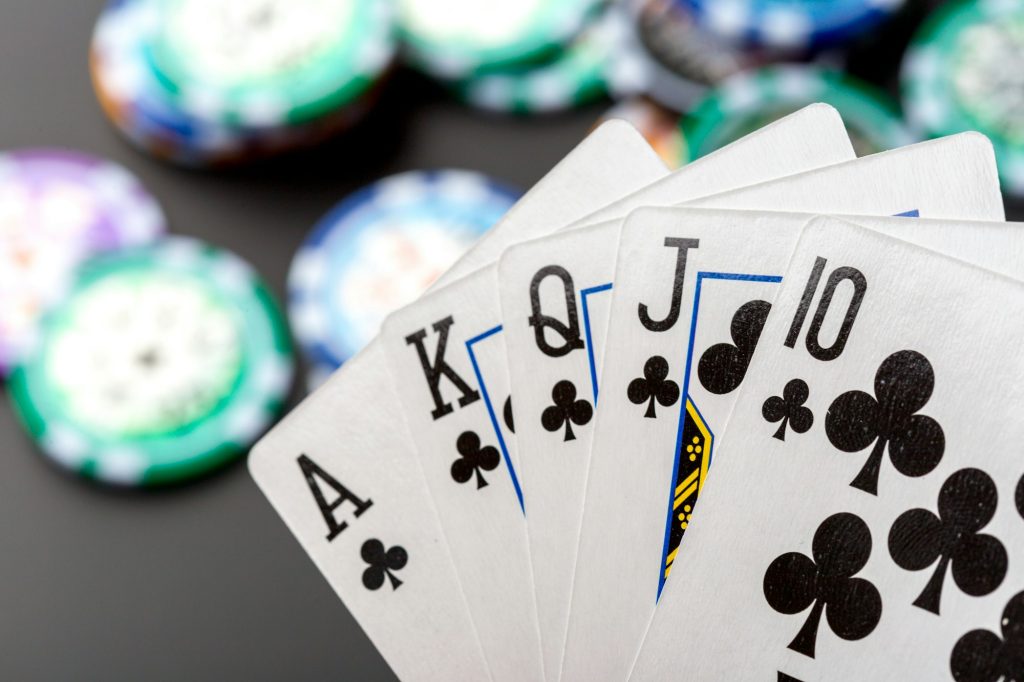
Royal Flush: A, K, Q, J, 10 of the same suit.
Straight Flush: Five consecutive cards of the same suit.
Four of a Kind: Four cards of the same rank.
Full House: A set of three cards of one rank and two cards of another rank.
Flush: Five cards of the same suit, but not in sequence.
Straight: Five consecutive cards of any suit.
Three of a Kind: Three cards of the same rank.
Two Pair: Two sets of pairs.
One Pair: Two cards of the same rank.
High Card: The highest card in the hand if no other hand is made.
Hijack
Position just before the cutoff.
High Card/The highest card
The lowest poker hand, weaker than a pair.
High Roller
A person who plays for high stakes.
Hold’em
(1) Shorter name for Texas Hold’em poker.
(2) The collective name of poker variants that feature community cards; the most popular ones are Texas Hold’em and Omaha.
Hole Cards
Hole cards that each player receives at the beginning of the hand (they are face down). A player can use them to make the best possible 5-card hand.
Hand
A hand means both the cards or combination of cards held by a particular player and the entire single hand.
Heads up
A hand or game played by only two players.
I
Implied Odds
Implied odds, or implied pot odds, are a modified version of the pot odds that are calculated when holding a draw. Implied odds take into account the fact that if a card that completes our hand appears on the table, there will be a chance to win a much larger pot. Therefore, your opponents’ future bets are also used to calculate implied odds, not just those already in the pot.
Kickers come in hands of less than five cards, such as four-of-a-kind, a set, two pairs and a pair. They decide the result when two players have hands of the same rank. In this case, the one whose kicker is higher wins.
L
A pre-flop play that involves calling the big blind.
A term referring to cards that have not yet been revealed and are probably still in the deck.
Short for “loose-aggressive”. Refers to a playing style or a person who plays a large number of hands (loose) in an aggressive manner (frequent raises).Leak
A weak point in a player’s style or strategy that causes him to lose money.Limit
1. The shorter name for fixed-limit poker is Fixed Limit, which means that the minimum and maximum bets are fixed in advance at all times.2. The amount of blind bets or maximum buy-in, determining how much you play for. This term may also refer to No-Limit or Pot-Limit games.Loose
A term for a player who plays many, very different starting patterns. Its opposite is tight, which plays only selected, strong hands.Low Card
A card that can be part of a low hand in games such as Stud Hi-Lo or Omaha Hi-Lo.
M
MTT (Multi Table Tournaments)
Multi-table tournaments in which, thanks to the large number of players, you can win the most money.
Mucking cards means throwing them down without showing them.Made Hand/Pre-made layout
A complete/finished poker hand that is usually difficult to improve.Makeup
The amount transferred by the stacker(s) to the sponsored player.Min-raise
The smallest possible raise at a given time.Monster
Very strong system.N
Nuts
The best possible arrangement in a given situation.O
Making a bet that exceeds the size of the pot.
The card in your hand is higher than the highest community card.
The pair in the hand is higher than all the community cards.
Outs are cards that, if they appear on the table, will complete the player’s hand.
Odds
The probability of obtaining a deal compared to a situation where a deal is not obtained.Offsuit
Two cards of different suits.Omaha
A variant of poker in which players are dealt four hole cards. To create the final 5-card hand, players must use two of the cards in their hand and three of the community cards on the board. The rest of the game rules are the same as in Texas Hold’em.Open Pair
A pair lying among the cards face up on the table.Open ended draw to a straight
Draw to a straight that is missing a card from one side or the other of the hand.Out of Position
A player has no position over his opponent when he must make a decision ahead of him in a given betting round.
P
Pot-Limit
In the Pot-Limit game, a player can place a single bet no higher than the current pot size.
Pot Odds
The ratio of the current pot size to the amount you must pay to continue playing that hand. The higher the pot odds, the better.
Push
Enter with all your chips (all in).
Postflop/After the flop
The part of the game that includes the flop and subsequent betting rounds.
Preflop/Before the flop
The part of the game that takes place after the cards have been dealt but before the flop.
Probe bet
Usually a small bet that is mainly intended to gauge the opponent’s reaction and gain information.
Pair
The lowest of poker hands: two cards of the same value.
Pass/Drop/Fold
Shedding cards. A player who folds no longer participates in the hand and loses the right to the pot.
Pocket Pair
Two cards of the same value in your hand.
Poker/Straight Flush
A hand consisting of five consecutive cards of the same suit.
Royal Flush/Royal Flush
A hand consisting of five consecutive cards, specifically from ten to ace, in the same suit. This is the strongest hand in poker.
Poker Tracker
A program that archives your hands and allows you to monitor your own and your opponents’ play.
Position
The position occupied by a player in relation to the dealer. The further down the order you are from the dealer, the better your position because it allows you to make decisions later in a given betting round.
A situation in which, on the flop or turn, each card on the board is a different suit.Raise
Placing an amount higher than the amount of the previous bet.Rake
Service money for the poker room (usually a percentage of each pot or tournament buy-in).Range
All combinations of cards that your opponent may currently have. If, for example, a player raises in starting position, his likely range of cards may be limited to high pairs.Rebuy
The amount of money a player pays to add chips to his or her pot during a tournament.Re-raise
Raising another player’s raise.River
The fifth and final community card.Runner-Runner
An incomplete poker hand that requires completion of specific cards on the turn and river.
Runner-up
Second place winner in the tournament.
S
Slow Play
Passive play with a strong hand. The purpose of this is to build the pot by drawing your opponents into play without revealing the strength of your cards.
Burncard
A card that is discarded (“burned”) by the dealer before the community cards are placed on the table to prevent cheating.
Split Pot
Dividing the pot between two or more holders of a hand of equal value.
Stack
The amount of chips or money that a player can use at the table.
Straight/Straight
The next five cards in value, e.g. 3-4-5-6-7
Suck-out
A situation when a player is lucky and defeats an opponent who had better cards for most of the hand.
Suit/Suit in the cards
Spades, clubs, hearts and diamonds.
Suited/In color
Cards of the same suit.
Suited connectors
Consecutive cards of the same suit.
Showdown
The final phase of the hand in which the remaining players show their cards to determine the winner. It takes place after the last round of bidding or play, the players have gone all in and no one can bid anymore.
Satellite
A qualifying tournament in which you can win a ticket to a more expensive tournament.
Seat
The player’s assigned seat at the table.
Second Barrel
Making a second bet on the turn after making a bet on the flop.
Semi-bluff
Making a bet or raise with cards that are not the best at the moment, but have the potential to improve.
Set
A three of a kind consisting of two cards from your hand and one from the table.
Shark
A very good, winning player who profits from the game in the long run. It is the opposite of fish.
Shorthanded
Game for three to six people. The opposite of full ring.
Short stack
A player with few stacks, usually less than 25BB.
Tell
An element of a player’s behavior that reveals the strength of his hand.Third Barrel
A bluff on the river, preceded by attempts to bluff on the flop and turn.Tight
A style of play that involves strict selection of starting hands. Shedding weak and medium cards.Tilt
A player’s mental state in which he or she is unable to make good decisions. It is caused by too strong, negative emotions, mainly caused by events at the table.Trips
A hand consisting of three cards of the same value, two of which are on the table and the third in the player’s hand.Turn
The fourth community card in Texas Hold’em and Omaha, as well as the second last round of betting.Trash/Trash Hand/Garbage
Worthless cards with little chance of winning.U
Underpair
A pair in your hand is lower than the weakest card on the board.
Under the Gun (UTG)
The player who is the first to make a decision in the first round of bidding. He sits directly to the left of the player in the big blind.
Whoopswing
A longer period of success in the game, but usually due to luck rather than skill.
V
Value is the value of the hand, and expected value is the profit you expect to make when making a given play. This means that a trade has value when it brings profits in the long run.Value bet
A bet aimed at increasing our winnings. It is made when we think we have the best hand. By making a value bet in such a situation, we can win more money than our opponent if he calls us.Villain
A colloquial term for an opponent in a hand.W
Lowest straight (ace to five). The ace plays the role of number one, the lowest card.